
Home/Rural Recycling Scheme
Rural recycling is changing from 1 March 2027
The Government has confirmed regulations for the Rural Recycling Scheme. Agrecovery will deliver the regulated scheme from 1 March 2027. The scheme will build on the voluntary schemes that have been operating for nearly 20 years, and will create a nationally coordinated way to fund and provide take-back services for specified agrichemicals, containers and farm plastics.
Home/Rural Recycling Scheme/Producers & importers
Information for producers, importers and brand owners
If your organisation makes, imports, owns a brand for, or otherwise places an in-scope product on the New Zealand market, it may have responsibilities under the regulated Rural Recycling Scheme. The scheme starts on 1 March 2027, and Agrecovery will help affected organisations understand what applies to them and prepare for the commencement of the scheme.
Home/Rural Recycling Scheme/Farmers & growers
Your rural recycling scheme
The regulated Rural Recycling Scheme starts on 1 March 2027. You do not need to change anything today. Keep using current Agrecovery services and instructions until we publish updated information.
Using the scheme will remain your choice.
Participation for farmers, growers, contractors and other rural users is voluntary.
Home/Rural Recycling Scheme/Merchants & retailers
Information for rural merchants and retailers
Rural merchants and retailers are an important and appreciated source of practical information for farmers and growers. Many of these locations are already approved Agrecovery collection sites.
Home/Rural Recycling Scheme/Local councils
Information for local councils
Regulations for the new Rural Recycling Scheme are confirmed. From 1 March 2027, Agrecovery will manage the regulated national product stewardship scheme for agrichemicals, their containers and farm plastics.
Home/Rural Recycling Scheme/Products & FAQs
Products covered and common questions
The Rural Recycling Scheme will initially cover four main product categories. Product use, packaging, material, size and preparation requirements determine whether a particular item can be accepted.
Home/Rural Recycling Scheme/In-scope product definitions
In-scope product definitions
How the regulations define the products the scheme covers. These are the definitions published by the Ministry for the Environment, reproduced here so you do not have to go looking for them.
Home/Rural Recycling Scheme/Glossary
Glossary
The terms used across this section, in plain language. These same definitions appear as tooltips wherever the terms are used on the other pages.
What you need to know
The date is set
The regulated scheme starts on 1 March 2027.
Producers fund it
Producers of in-scope products will fund the scheme through scheme fees.
It stays your choice
Farmers, growers and other rural users can choose whether to use the take-back services. Participation is voluntary.
Agrecovery delivers it
Agrecovery is responsible for delivering the scheme.
Products covered
The Rural Recycling Scheme will initially cover four main product categories.
Agrichemicals and their containers
Agrichemicals sold in plastic containers and drums of 1,000 litres or less, including household pest and weed control products.
Bale wrap and silage sheet
Plastic bale wrap and silage sheet.
Small agricultural product bags
Plastic bags of 16–40 kg when full, containing products such as seed, feed, fertiliser, soil and crop inputs, and farm and animal supplements.
Bulk agricultural product bags
Bulk woven polypropylene bags over 40 kg when full, containing products such as seed, feed, fertiliser, soil amendments, minerals and bulk nutrition.
Choose the information you need
I produce, import or own a brand that includes a regulated product
You may need to register, report the quantity of in-scope product you place on the New Zealand market, and pay scheme fees.
Information for producers and importers →Our brand already belongs to an existing voluntary Agrecovery scheme
Your existing relationship with Agrecovery is a great starting point. We will confirm what information can carry across and what needs to be updated for the regulated scheme.
Information for existing brands →I am a farmer, grower or contractor
You do not need to change what you are doing today. Participation in the regulated scheme will remain voluntary. Agrecovery will publish confirmed collection and preparation information before the regulated scheme commences. In the meantime, please continue to use existing Agrecovery and Plasback services.
Information for farmers and growers →I am a rural merchant or retailer
Your customers may look to you for practical information. Agrecovery will work directly with merchants involved.
Information for merchants and retailers →I have another question
Check the FAQs, or contact Agrecovery if you cannot find the answer you need.
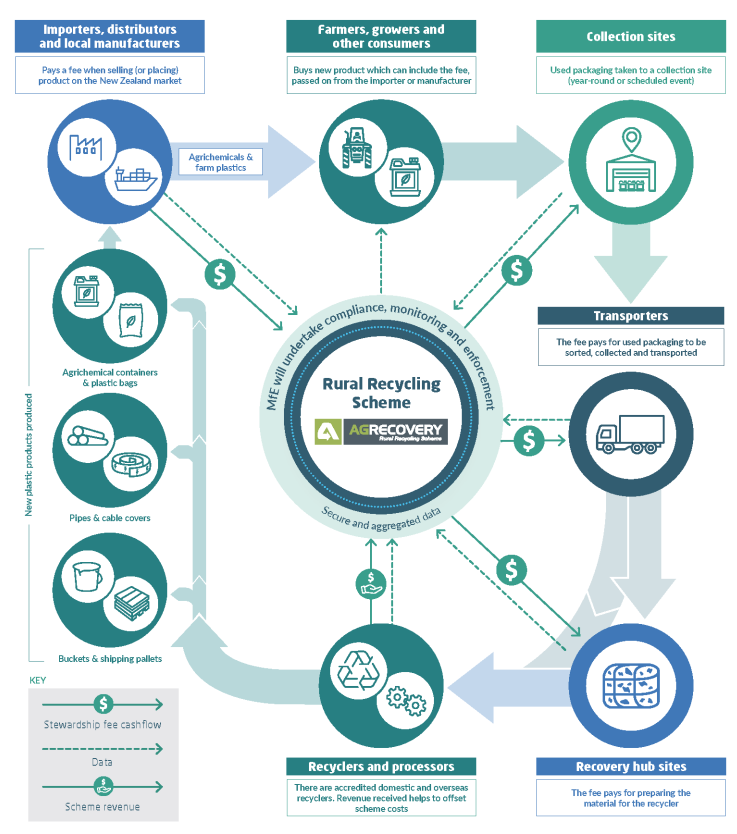
How the scheme works
Who pays, where used packaging goes, and how it is recovered.
Is my organisation likely to be affected?
Your organisation may be affected if it:
- manufactures an in-scope product for sale in New Zealand
- imports an in-scope product
- owns or licenses a brand used on an in-scope product
- imports or manufactures an in-scope product for use in its own organisation
It depends on the product and the supply chain
The responsible organisation will depend on the product and the way it is supplied into New Zealand. Retailing or distributing another organisation’s product does not, by itself, provide enough information to determine responsibility. If you are unsure, please contact Agrecovery with the product, brand and supply-chain details.
Products initially covered
Agrichemicals and their containers
Sold in plastic containers and drums of 1,000 litres or less, including household pest and weed control products.
Bale wrap and silage sheet
Plastic bale wrap and silage sheet.
Small agricultural product bags
16–40 kg when full — seed, feed, fertiliser, soil and crop inputs, farm and animal supplements.
Bulk agricultural product bags
Bulk woven polypropylene bags over 40 kg when full.
Scheme fees
Obligated producers will fund the Rural Recycling Scheme through scheme fees, based on the quantity of in-scope product placed on the New Zealand market.
The fee rates are below. These have not changed following consultation. They typically range from less than 0.2 per cent up to around 1.7 per cent of product cost, and are generally less than 1 per cent.
| Product | Unit | Fee |
|---|---|---|
| Agrichemicals and their containers — packaging part of the fee | ||
| Containers up to 60 litres | per litre | $0.10 |
| Containers over 60 litres, and less than an IBC | per litre | $0.025 |
| IBC (approximately 1,000 litres) | per litre | $0.02 |
| Agrichemicals and their containers — chemical part of the fee | ||
| Group 1 — chemicals unlikely to be brought for disposal, because they are typically used up | per litre | $0.01 |
| Group 2 — chemicals with the lowest disposal cost | per litre | $0.03 |
| Group 3 — chemicals with a higher disposal cost, in containers up to 60 litres | per litre | $0.04 |
| Group 3 — chemicals with a higher disposal cost, in containers of 60 litres or more | per litre | $0.06 |
| Household pest and weed control products | ||
| Container | per container | $0.10 |
| Group 1 — chemicals unlikely to be brought for disposal | per kg or litre | $0.02 |
| Group 2 — chemicals with the lowest disposal cost | per kg or litre | $0.08 |
| Group 3 — chemicals with a higher disposal cost | per kg or litre | $0.10 |
| Farm plastics | ||
| Bale wrap | per tonne | $462.02 |
| Silage sheet | per tonne | $462.02 |
| Small bags | per bag | $0.20 |
| Large bags | per bag | $3.58 |
What that works out to as a share of product cost
| Product | Fee per unit | Typical purchase price | Fee as % of cost |
|---|---|---|---|
| Bale wrapped feed | $0.52 | $30–$60 per bale | 0.87–1.73% |
| Large fertiliser bag | $3.58 | $400–$1,000 per bag | 0.36–0.9% |
| Small feed or fertiliser bag | $0.20 | Over $100 per bag | Under 0.2% |
| 20-litre container of group 2 agrichemicals | $2.60 | Varies widely — for example $181–$1,516 across the range of New Zealand’s largest agrichemical supplier | 0.7–1.4% |
Source: Ministry for the Environment. Read the regulations and the full fee information in the Waste Minimisation (Agrichemicals and Farm Plastics) Regulations 2026 →
Agrecovery will publish reporting units, calculation examples and the payment process before fees become payable.
What your organisation needs to do
Obligated producers not currently signed up to a voluntary Agrecovery scheme
Pre-register with the Rural Recycling Scheme.
Providing your contact details now means Agrecovery can send you the confirmed instructions when the process opens. This initial contact does not replace any formal registration step that will be required.
Obligated producers already signed up to a voluntary Agrecovery scheme
You do not need to do anything right away. Your existing relationship with Agrecovery means we may already hold useful organisation, contact, product, reporting or payment information.
Agrecovery is finalising the full registration process. Do not assume your current participation automatically completes the regulated scheme requirements. We will be in touch with more information over the coming weeks to confirm your regulatory obligations.
Need help?
The three questions producers and importers ask most. The full list covers products, collection and what happens next.
What should potentially obligated producers do now?
. Providing contact details does not replace any formal registration step that may be required.
Is registration open?
Agrecovery is finalising the full registration process. More information will be provided over the coming weeks.
Do existing Agrecovery brands need to register again?
Existing Agrecovery brands do not need to complete pre-registration. However, do not assume your current participation automatically meets the regulated requirements. We will confirm what is required over the coming weeks.
What changes for me?
The scheme will bring the initial product categories into one nationally coordinated system delivered by Agrecovery. The goal is to make things easy and efficient for you to recycle more of the plastics you use.
What can I recycle?
Agrichemicals and containers
Agrichemicals, and eligible plastic containers and drums up to and including 1,000 litres.
Bale wrap and silage sheet
Plastic bale wrap and silage sheet.
Small bags
Small plastic bags used for completed agricultural products such as seed, feed and fertiliser, 16–40 kg.
Bulk bags
Bulk woven polypropylene agricultural product bags, over 40 kg.
How it will work
Where will I recycle it?
The core network will use confirmed collection sites, rural retail locations, recycling events and approved collection partners. What is available will depend on the product and your region.
We will publish more before 1 March 2027.
Will I have to pay?
Farmers and growers will not have to pay. There will be no direct charge to use the core take-back service for eligible, correctly prepared material.
A service outside the core scheme may have a charge. More information will be provided before the regulated scheme commences on 1 March 2027.
Do I need to register?
You need to be an Agrecovery member to recycle through Agrecovery. There is no cost to becoming a member.
Not a member yet?
Register to become a member.
Already a member? You do not need to do anything further.
What about plastic already on farm?
Eligible material already on farm will be accepted, provided it is within the regulated product scope and meets preparation and presentation requirements.
Agrichemicals: two things to know
Legacy residual agrichemicals
The scheme is designed to handle residual agrichemicals left after normal use, not to provide a disposal route for large volumes of unused product.
Agrichemicals previously covered by Agrecovery’s voluntary scheme will be eligible where they meet the regulated take-back criteria. Free collection limits apply per booking.
Orphan agrichemicals
Agrichemicals that cannot be clearly identified from their product or brand label, or that are no longer in their original packaging, are treated as orphan agrichemicals.
These are not eligible for the regulated take-back service.
Your role
Depending on your arrangement with Agrecovery, your organisation may:
- provide current product and preparation information
- distribute approved collection liners
- continue as an approved collection site
- promote confirmed local collection sites and Recycling Rallies
Do not assume every store will accept every product category
Agrecovery will confirm the role, accepted materials and operating requirements with each participating location.
Check whether producer obligations also apply
If your organisation imports an in-scope product, manufactures one, or owns a private-label brand, it may also need to follow the producer and importer process.
What customers are likely to ask
Staff should use Agrecovery’s current guidance to answer these, and refer unresolved product or service questions to Agrecovery.
Is this product accepted?
How should I prepare it?
Is there a charge?
Where is the nearest collection option?
Do I need a liner?
Can I return material bought from another retailer?
When you are not sure
Staff should use Agrecovery’s current guidance, and refer unresolved product or service questions to us.
What the scheme covers
The regulated scheme covers:
- agrichemicals and their containers and drums
- bale wrap and silage sheet
- agricultural bagged products
Why this matters for councils
For councils and local government, the new scheme represents an important step towards a more consistent national approach to managing rural plastics and agrichemical products.
It also provides an opportunity to develop clearer responsibility for how these materials are recovered and managed.
What this means for councils
There is no immediate change
For now, there is no immediate change to existing Agrecovery services.
As we prepare for 1 March 2027, Agrecovery will continue to work with councils and local government partners to share information about the new scheme, its collection network and how it will operate across different regions.
We will be in touch as further information becomes available and as opportunities for regional coordination develop.
Working together
Our aim is to make recycling more accessible for farmers and growers, while helping reduce the burning and burying of rural plastics. This is an area where your support will be important, particularly in helping us reach rural communities and reinforce appropriate recycling pathways.
We also recognise the important role councils play in connecting with rural communities and supporting practical, locally relevant solutions.
Products covered
Agrichemicals and plastic containers
Agrichemicals within the regulated scope, and their eligible plastic containers and drums up to and including 1,000 litres.
Typical examples include crop protection products and other registered agricultural compounds.
Note
Specified household pest and weed control products are included, but have separate safety and collection instructions.
Containers & drums ≤1,000LHousehold pest & weed
Plastic bale wrap and silage sheet
Plastic wrap and sheet used for baled silage, baleage and silage storage.
Keep separate
Twine, netting, tyres, metal and unrelated plastics.
Small agricultural product bags
Eligible plastic bags of 16–40 kg when full, used for completed agricultural products such as seed, feed, fertiliser, soil and crop inputs, and farm and animal supplements.
Bulk woven polypropylene bags
Eligible woven polypropylene bags over 40 kg when full, used for bulk agricultural products such as seed, feed, fertiliser, soil amendments, minerals and nutrition products.
Not included simply because it is used on farm
The initial scheme does not cover every rural plastic. Products such as baling twine, netting, irrigation pipe, plant pots, shrink wrap and tunnel covers are not part of the four initial regulated categories unless Agrecovery identifies a separate programme.
Frequently asked questions
What has changed?
The Government has confirmed regulations for the Rural Recycling Scheme. The regulated scheme starts on 1 March 2027 and will be delivered by Agrecovery.
Who has to participate?
Organisations that manufacture, import, own a brand for, or otherwise place an in-scope product on the New Zealand market may be obligated. Which organisation is responsible depends on the product and the supply chain. Farmers and growers can choose whether to use the take-back services.
What should potentially obligated producers do now?
. Providing contact details does not replace any formal registration step that may be required.
Is registration open?
Agrecovery is finalising the full registration process. More information will be provided over the coming weeks.
Do existing Agrecovery brands need to register again?
Existing Agrecovery brands do not need to complete pre-registration. However, do not assume your current participation automatically meets the regulated requirements. We will confirm what is required over the coming weeks.
Who pays the scheme fees?
Obligated producers of in-scope products pay the scheme fees. The fee rates are set out on the producers and importers page. Agrecovery will publish reporting units, calculation examples and the payment process before fees become payable.
Do farmers and growers have to use the scheme?
No. Participation by farmers, growers, contractors and other users is voluntary.
Is there a charge when I return material?
There will be no direct charge for the core take-back service for eligible, correctly prepared material. Services outside the core scheme may have a charge.
Where can material be returned?
The network will use confirmed collection sites, rural retail locations, recycling events and approved collection partners. We will publish more closer to 1 March 2027.
Is every farm plastic covered?
No. Plastic type, or the fact that something is used on a farm, does not on its own make a product eligible.
Can I return plastic that is already on farm?
Eligible material already on farm will be accepted if it is within scope and meets the preparation and presentation requirements.
How clean does material need to be?
It must meet the instructions for that product category. Dirt, stones, moisture, residue, organic material and mixed plastics can all stop material from being recycled.
I am a contractor. Can I use the scheme?
Yes. Participation for contractors and other rural users is voluntary. Eligible material must meet the same product, preparation and presentation requirements.
I am a contractor, council or industry organisation. Where do I go?
Use the information for the audience you support, link people to the current Agrecovery pages, and contact us if you would like to support a collection service, briefing or sector communication.
Where can I get help?
Use Agrecovery’s contact form or call 0800 247 326.
Definitions for in-scope products
Agrichemicals
Liquid and solid chemical products used for agricultural purposes such as plant protection (herbicides, insecticides, fungicides), and veterinary medicines such as anthelmintics.
Household pest and weed control products
Liquid and solid agrichemicals that are intended for domestic use around the home or garden to manage or eliminate pests, weeds, and other unwanted organisms, and available to the public through standard retail outlets.
Bale wrap
LLDPE (Linear Low-Density Polyethylene) to encase bales of feed for the purpose of feeding livestock.
Silage sheet
LDPE (Low Density Polyethylene) sheeting for covering silage feed pits for the purposes of feeding out to livestock.
Agricultural product types
The bag categories cover packaging used for completed agricultural products. This is what those product types mean.
Seed
All seeds used in the primary sectors for sowing such as pasture, arable, horticultural, and specialty crop seeds.
Feed
Livestock, equine, and poultry feeds. Including grain-based rations, protein and energy supplements, and specialty feeds.
Fertiliser
Conventional and specialty fertilisers used to enhance horticultural production, crop and pasture growth.
Soil and crop inputs
Inputs to improve soil structure, fertility, and overall productivity, including soil conditioners such as lime, gypsum, biochar, and zeolite. Excludes home garden products used for improving soil structure, including potting and planting mixes, mulch, pumice, vermiculite and perlite.
Farm and animal supplements
Mineral supplements, lick blocks, electrolytes, and other products used to support livestock health, performance and nutrition such as mineral supplements, lick blocks and electrolytes.
More information
These definitions are a plain summary. The regulations themselves are the authoritative source for what is and is not in scope.
Definitions on this page are sourced from the Ministry for the Environment and are used under the Creative Commons Attribution 4.0 International licence.